Buying things for the home should make daily life easier, not just fill drawers, shelves, and cabinets with products that looked useful for five minutes online.
That is why a practical home finds checklist can help. Instead of buying every trending gadget, the better approach is to ask a few simple questions: Does this solve a real problem? Will I use it often? Is it easy to clean, store, and maintain? Does it work for my home size and routine?
This guide is designed as an internal hub for practical home buying decisions. It will help you decide what to buy, what to skip, and what to upgrade first across everyday home helpers, cleaning tools, kitchen gadgets, home organization products, small space solutions, and smart practical finds.
Bottom Line: The Best Home Finds Solve Repeated Problems
A practical home find is not just something that looks clever. It is something that helps with a repeated household problem.
That could mean making cleaning less frustrating, keeping small spaces more organized, improving a daily kitchen task, reducing clutter, or making a common routine easier to manage.
The best products usually have three things in common:
- They solve a problem you already have.
- They fit naturally into your existing routine.
- They are easy enough to use, clean, and store regularly.
The products to skip are usually the opposite. They look interesting, but they do not match your home, your habits, or the amount of space you actually have.
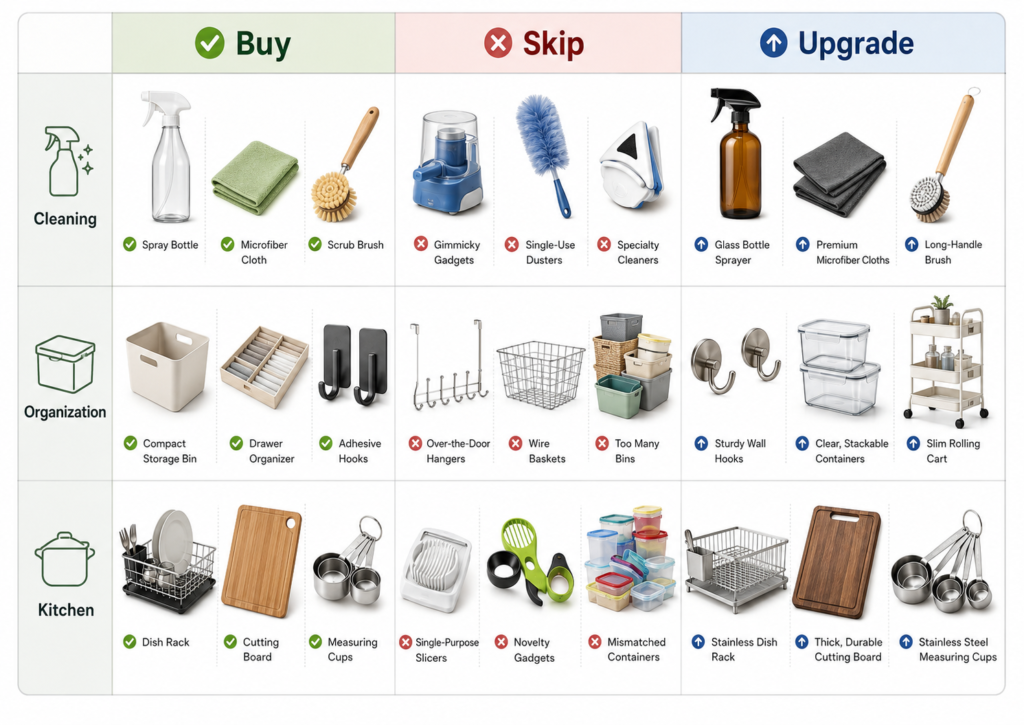
How to Use This Home Finds Checklist
Before buying any home product, run it through this simple checklist. This works for cleaning tools, kitchen gadgets, organizers, storage bins, small-space products, and smart home helpers.
| Checklist Question | Why It Matters | Good Sign | Warning Sign |
|---|---|---|---|
| Does it solve a real problem? | Prevents random buying | You can name the exact issue it helps with | You only want it because it looks interesting |
| Will you use it often? | Improves value over time | It fits a weekly or daily routine | It is only useful for rare situations |
| Is it easy to clean? | Reduces frustration | Simple parts, washable surfaces, low maintenance | Too many tiny parts or awkward cleaning steps |
| Can you store it easily? | Important for small homes and apartments | Compact, stackable, foldable, or multipurpose | Bulky item with no clear storage spot |
| Does it replace a weaker item? | Makes upgrading more useful | It improves something you already use | It adds clutter without replacing anything |
If a product passes most of these questions, it may be worth considering. If it fails two or more, it may be better to skip or delay the purchase.
What to Buy: Practical Home Finds Worth Considering
The best home finds are not always the most exciting. Often, they are simple products that quietly make daily tasks easier.
1. Buy Products That Fix Repeated Cleaning Frustrations
Cleaning tools are worth considering when they reduce effort, reach difficult areas, or make a routine easier to keep up with.
Examples may include better scrub brushes, extendable dusters, compact vacuums, microfiber cleaning cloths, grout brushes, reusable mop pads, or cleaning caddies that keep supplies together.
The key is not to buy every cleaning tool available. The goal is to identify where cleaning feels annoying in your home and choose tools that address that specific problem.
For more focused ideas, you can browse the Cleaning Tools section.
2. Buy Kitchen Gadgets That Save Time Without Adding Hassle
A useful kitchen gadget should make food prep, cooking, storage, or cleanup easier. It should not create more work than it saves.
Practical examples may include a good can opener, compact food chopper, drawer organizer, silicone spatula set, measuring tools, sink strainer, storage containers, or a simple cutting board upgrade.
Before buying a kitchen product, ask whether it will help with a task you already do often. If it only works for one very specific recipe or cooking trend, it may not deserve space in your kitchen.
You can explore more practical ideas in the Kitchen Gadgets section.
3. Buy Home Organization Products That Match Your Actual Space
Organizers can be helpful, but only when they fit the space and the items you already own. Buying bins without measuring first is one of the easiest ways to create more clutter.
Useful organization products may include drawer dividers, under-sink organizers, shelf risers, stackable bins, cable organizers, closet baskets, pantry labels, and storage trays.
The best organizer is not always the prettiest one. It is the one that makes items easier to see, reach, and return to their place.
For more ideas, visit the Home Organization section.
4. Buy Small-Space Solutions That Earn Their Footprint
Small homes, apartments, dorms, and compact kitchens need products that work harder. A product should either save space, serve more than one purpose, or make limited storage easier to manage.
Good examples include collapsible laundry baskets, slim rolling carts, over-the-door organizers, foldable drying racks, wall-mounted holders, nesting bowls, and compact storage containers.
For small spaces, avoid oversized products unless they solve a major problem. Even a useful item can become annoying if it has nowhere to live.
You can find more space-conscious ideas in the Small Space Solutions section.
5. Buy Everyday Home Helpers That Remove Small Daily Annoyances
Some of the most useful home finds are not dramatic. They simply remove small annoyances that happen again and again.
This can include cord clips, door draft stoppers, laundry sorters, entryway trays, reusable bags, furniture sliders, cabinet bumpers, non-slip mats, or simple hooks for bags and keys.
These products are often worth considering because they support daily routines without requiring a major lifestyle change.
For broader ideas, browse Everyday Home Helpers.
What to Skip: Home Products That Often Become Clutter
Not every clever-looking product deserves a place in your home. Some products look useful online but do.com/category/everyday-home-helpers/”>Everyday Home Helpers.
What to Skip: Home Products That Often Become Clutter
not fit real routines.
1. Skip Products That Solve a Problem You Do Not Have
This is the most common buying mistake. A product may be useful for someone else, but unnecessary for your home.
For example, a specialized kitchen gadget may be helpful for someone who cooks that specific food every week. But if you rarely make that dish, the gadget may sit unused.
2. Skip Single-Use Gadgets Unless You Use Them Often
Single-use products are not automatically bad. Some are helpful if they support a routine you already have.
But if a product only does one narrow task and you rarely need that task done, it may not be a smart buy.
Before buying a single-use gadget, ask: Would I use this at least monthly? Does it do the job better than a tool I already own? Is it easy to store?
3. Skip Bulky Products Without a Storage Plan
A product can be useful and still be wrong for your home if it is too bulky. This matters especially for apartments, small kitchens, shared homes, and homes with limited closets.
Before buying, decide where the item will live. If there is no clear place for it, it may create more friction than convenience.
4. Skip Products With Too Many Parts to Clean
Cleaning and maintenance are part of ownership. If a product has many small parts, awkward corners, or complicated assembly, it may become frustrating over time.
This is especially important for kitchen gadgets, bathroom tools, pet-related products, and anything used with water, food, dust, or soap.
A simple product that is easy to rinse, wipe, or store often beats a more complicated product that feels like a chore.
5. Skip Viral Products With Unclear Use Cases
A product going viral does not mean it belongs in your home. Viral videos often show the most exciting use case, not the everyday reality of storing, cleaning, and using the product long-term.
For a better decision-making approach, read How to Choose Home Gadgets That Are Actually Useful, Not Just Viral.
What to Upgrade First: The Smartest Order for Home Improvements
If you are trying to improve your home without overspending, upgrades should start with the items you use most often.
The best first upgrades are usually not luxury items. They are products that reduce repeated friction in daily life.
1. Upgrade Worn-Out Daily Tools First
Start with products you already use all the time. This may include your broom, mop, dish brush, cutting board, laundry basket, drawer organizer, food storage containers, or entryway storage.
If something is broken, frustrating, hard to clean, or no longer doing its job well, an upgrade may have immediate value.
2. Upgrade High-Friction Areas Next
High-friction areas are places where small problems happen repeatedly. Common examples include the kitchen sink, under-sink cabinet, pantry, bathroom counter, laundry area, entryway, closet, and junk drawer.
Look for the area that annoys you most often. Then choose a simple product that reduces that specific problem.
3. Upgrade Storage Before Buying More Stuff
If your home feels messy, the answer is not always more products. Sometimes the better first step is better storage for what you already own.
Drawer dividers, shelf risers, storage bins, baskets, and labels can make existing items easier to manage. But measure first and avoid buying random containers without a plan.
4. Upgrade Small Items That Improve Daily Flow
Small upgrades can make a home feel easier to use. This may include hooks near the door, a tray for keys, cable clips near a desk, a better dish rack, or a laundry sorter that reduces floor piles.
These are not dramatic changes, but they can reduce daily decision fatigue.
5. Upgrade Smart Only When It Adds Practical Value
Smart home products can be helpful, but they are not automatically better. A smart plug, motion light, timer, or simple sensor may be useful when it solves a real routine problem.
However, smart products may not be necessary if a simple manual product works just as well.
For a practical approach, visit the Smart Practical Finds section.
The Practical Home Finds Buy / Skip / Upgrade Table
Use this quick comparison table when deciding whether a product deserves a place in your home.
| Product Type | Buy It If | Skip It If | Upgrade First If |
|---|---|---|---|
| Cleaning Tools | It makes a repeated cleaning task easier | You already own a tool that works well | Your current tool is worn out, awkward, or ineffective |
| Kitchen Gadgets | It helps with food prep, storage, or cleanup you do often | It only works for one rare task | You use the current item daily and it frustrates you |
| Organizers | It fits your space and makes items easier to access | You have not measured the space | A drawer, cabinet, or closet causes daily clutter |
| Small-Space Products | It saves space or serves more than one purpose | It is bulky with no storage plan | Your current setup wastes limited space |
| Smart Home Helpers | It automates a real routine or solves a practical issue | It adds complexity without clear benefit | A simple smart function would improve daily convenience |
| Everyday Home Helpers | It removes a small repeated annoyance | It is only interesting because it is trending | You deal with the same small problem every day |
A Room-by-Room Home Finds Checklist
Another way to shop wisely is to look at each room separately. This prevents buying random products and helps you focus on actual household pain points.
Kitchen Checklist
- Is food prep taking longer than necessary?
- Are drawers difficult to open because they are cluttered?
- Are food containers mismatched or hard to stack?
- Is the sink area messy after dishes?
- Do you need better storage before buying another gadget?
Good kitchen finds usually help with prep, cleanup, storage, or access. Avoid gadgets that only look useful but do not match the way you cook.
Bathroom Checklist
- Are cleaning tools easy to reach?
- Is counter space being wasted?
- Are toiletries difficult to organize?
- Does the shower area need better storage?
- Are towels, cleaning supplies, or refills stored logically?
For bathrooms, prioritize products that handle moisture well, clean easily, and do not crowd small surfaces.
Laundry Area Checklist
- Do clothes pile up because sorting is inconvenient?
- Is there a place for detergent and supplies?
- Do you need a better drying solution?
- Would a compact hamper or sorter help?
- Can the product be stored when not in use?
Laundry helpers are most useful when they reduce piles, make sorting easier, or improve storage in a tight area.
Entryway Checklist
- Do keys, shoes, bags, or mail pile up near the door?
- Is there a clear landing spot for daily items?
- Would hooks, trays, or baskets reduce clutter?
- Do you need vertical storage instead of more floor storage?
- Is the solution simple enough for everyone in the household to use?
The entryway works best with simple systems. If the solution is too complicated, people may not use it consistently.
Bedroom and Closet Checklist
- Are clothes hard to find?
- Are drawers overfilled?
- Do shoes, accessories, or laundry need better zones?
- Would shelf dividers, bins, or under-bed storage help?
- Are you organizing items you actually use, or storing things you should remove?
Bedroom organization products are most useful when they make daily items easier to access, not when they simply hide clutter.
Common Mistakes When Buying Home Finds
Even practical shoppers can end up with products they do not use. These are some of the most common mistakes to avoid.
Mistake 1: Buying Before Measuring
This is especially common with organizers, bins, shelves, drawer dividers, under-sink racks, and small-space furniture.
Measure the width, depth, and height of the space before buying. Also consider doors, pipes, hinges, handles, and anything else that may block the product from fitting properly.
Mistake 2: Choosing Looks Over Function
A clean-looking product can still be inconvenient. Before choosing based on appearance, check whether it is sturdy, easy to clean, easy to access, and appropriate for the items you need to store.
Mistake 3: Ignoring Maintenance
Some products work well at first but become annoying because they are hard to clean or maintain. This matters with kitchen gadgets, cleaning tools, filters, storage containers, and anything with moving parts.
Always check care instructions and follow the manufacturer’s guidance when cleaning or using home products.
Mistake 4: Buying Too Many Organizers at Once
Organization works better when you solve one area at a time. Buying too many containers, baskets, or bins before sorting your items can lead to more clutter.
Start with one drawer, one shelf, one cabinet, or one daily routine. Then adjust from there.
Mistake 5: Assuming Expensive Means More Useful
A higher price does not always mean a better fit for your home. Sometimes a simple, affordable product solves the problem well enough.
Focus on the job the product needs to do. Then decide whether the extra features are actually useful for your routine.
Simple Buying Criteria for Practical Home Finds
When comparing products, use clear criteria instead of relying only on photos or product names.
| Buying Criteria | What to Look For | Why It Helps |
|---|---|---|
| Usefulness | Solves a real repeated problem | Prevents impulse buying |
| Ease of Use | Simple setup and clear function | Makes it more likely you will use it often |
| Storage | Compact, stackable, foldable, or easy to place | Reduces clutter |
| Cleaning | Easy to wipe, rinse, wash, or maintain | Prevents the product from becoming a chore |
| Durability | Materials suitable for the intended task | Improves long-term value |
| Fit | Right size for your room, drawer, cabinet, or counter | Helps avoid returns and wasted space |
| Frequency | Useful daily, weekly, or during a repeated routine | Gives the product a clear purpose |
How to Build Your Own Home Finds Priority List
If you want to improve your home gradually, create a simple priority list before shopping.
Step 1: List Your Top 5 Home Frustrations
Walk through your home and write down the small problems that happen often. These might include messy drawers, hard-to-clean corners, crowded counters, tangled cords, overflowing laundry, or poor pantry storage.
Step 2: Rank Them by Frequency
Put the most repeated problems at the top. A small issue that bothers you every day may be more important than a bigger issue that only happens once in a while.
Step 3: Look for Simple Fixes First
Before buying an expensive product, check whether a simple tool, organizer, hook, tray, basket, or cleaning helper can solve the problem.
Step 4: Upgrade What You Already Use
If an item is already part of your routine, upgrading it often makes more sense than adding a brand-new product category.
Step 5: Buy One Solution, Test It, Then Adjust
Do not overhaul every room at once. Try one practical solution, see whether it fits your routine, and then decide what to improve next.
Best First Upgrades for Most Homes
If you are not sure where to start, these areas are often worth checking first because they affect everyday routines.
1. Food Storage Containers
Mismatched containers can waste cabinet space and make leftovers harder to manage. A stackable set with clear lids or consistent sizing may be useful for many kitchens.
Skip this upgrade if your current containers are already easy to store, clean, and use.
2. Drawer Organizers
Drawer organizers can help in kitchens, bathrooms, offices, and bedrooms. They work best when they match the drawer size and the items you use most.
Measure first and avoid buying organizers just because they look tidy in photos.
3. Better Cleaning Brushes or Cloths
A few practical cleaning tools can make routine cleaning less frustrating. Look for tools that match the surfaces you clean most often.
Follow manufacturer instructions for surfaces, cleaning products, and tools, especially around delicate materials.
4. Entryway Hooks or Trays
If daily items pile up near the door, simple hooks, trays, or small baskets can help create a clear landing zone.
This is often more practical than buying a large furniture piece if the problem is small.
5. Under-Sink Organization
Under-sink areas often become messy because of pipes, cleaning bottles, trash bags, and extra supplies. A properly measured organizer can make this space easier to use.
Check pipe placement and cabinet dimensions before buying.
6. Laundry Sorting Help
If laundry piles are a recurring issue, a sorter, hamper, or compact basket system may make the routine easier.
Choose something that fits your space and household habits. A large sorter may not work well in a very small apartment.
When a Home Find Is Worth Paying More For
Not every product needs to be premium. However, paying more may make sense in a few situations.
- You use the item daily or weekly.
- The cheaper version breaks, bends, leaks, or wears out too quickly.
- The upgrade saves noticeable time or effort.
- The product improves safety, stability, or ease of use.
- The item replaces several weaker products.
For example, a sturdy dish rack, durable cleaning tool, well-designed organizer, or reliable kitchen helper may be worth considering if it supports a routine you already have.
But if the product is only for occasional use, a simple option may be enough.
When the Cheaper Option Is Good Enough
The cheaper option may be perfectly reasonable when the product is simple, low-risk, easy to replace, and not used heavily.
This may apply to basic baskets, simple Is Good trays, cleaning cloths, drawer bins, hooks, or low-use storage items.
The goal is not to buy the most expensive product. The goal is to buy the right level of product for the job.
Practical Home Finds by Category
Use these category guides to continue exploring practical ideas based on your current home problem.
- Smart Finds for Everyday Home Problems: Practical Home Gadgets Guide — a broad guide to useful home products that solve real household issues.
- How to Choose Home Gadgets That Are Actually Useful, Not Just Viral — a focused guide for avoiding random gadget purchases.
- Cleaning Tools — for easier home cleaning, maintenance, and everyday mess control.
- Kitchen Gadgets — for practical cooking, prep, storage, and cleanup helpers.
- Home Organization — for storage, decluttering, drawers, closets, shelves, and cabinets.
- Small Space Solutions — for apartments, compact kitchens, small rooms, and limited storage.
- Smart Practical Finds — for simple smart products that support real routines.
Final Home Finds Checklist Before You Buy
Before adding a home product to your cart, ask these questions:
- What exact problem does this solve?
- How often will I use it?
- Where will I store it?
- Is it easy to clean or maintain?
- Does it fit my space?
- Does it replace something weaker?
- Is there a simpler solution?
- Would I still want it if it were not trending?
- Does it match my actual routine?
- Who in my home will use it?
If you can answer these clearly, the product may be worth considering. If the answers feel vague, it may be better to wait.
FAQ: Practical Home Finds Checklist
What is a home finds checklist?
A home finds checklist is a simple buying guide that helps you decide whether a home product is useful, unnecessary, or worth upgrading. It focuses on real household problems instead of random trends.
What home products should I buy first?
Start with products you use often or areas that cause repeated frustration. Common first upgrades include cleaning tools, drawer organizers, food storage containers, entryway storage, laundry helpers, and under-sink organization.
What home gadgets should I skip?
Skip gadgets that solve problems you do not have, take up too much space, have too many parts to clean, or only work for rare tasks. A product may be clever but still unnecessary for your home.
Are viral home gadgets worth buying?
Some viral gadgets can be useful, but popularity alone is not enough. Look at whether the product fits your space, routine, storage needs, and actual household problems.
How do I know if a home product is practical?
A practical home product should be easy to use, easy to store, simple to maintain, and helpful for a task you do regularly. It should make daily life easier without creating extra clutter.
Should I buy cheap or expensive home products?
It depends on how often you use the item. For daily-use products, paying more for durability and ease of use may make sense. For occasional-use items, a simple affordable option may be enough.
What is the best way to avoid clutter from home finds?
Buy for a specific problem, measure before purchasing, choose products with a clear storage spot, and avoid buying multiple organizers before sorting the items you already own.
Conclusion: Buy for the Problem, Not the Trend
The best practical home finds are not always the newest, smartest, or most talked-about products. They are the items that make your real home easier to clean, organize, cook in, move through, and maintain.
Use this home finds checklist before buying anything new. Buy what solves a repeated problem. Skip what only looks interesting. Upgrade the items you already use often.
That approach keeps your home more functional, your spending more intentional, and your product choices more practical.
Pingback: Are Airtight Pantry Containers Worth It? What to Decant